
Privacy's Defender: My Thirty-Year Fight Against Digital Surveillance
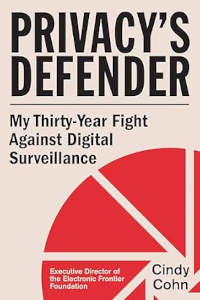
This book is a memoir of sorts of Cindy Cohn who was a lawyer for, and then eventually the executive director of the Electronic Frontier Foundation (EFF). The book is divided into three parts talking about some of the biggest cases, she and the EFF dealt with over the last 30 years or so.
One of the biggest themes of the book was how she and the EFF fought to protect our privacy on the internet. She opened the book talking about what privacy does.
Privacy limits the power of individuals over each other. It limits the power of governments over us. It also limits the power of corporations over us. Privacy allows people to protect themselves while creating a space to think, connect, communicate, share, and most critically to organize for change. Put another way, privacy is important to each of us individually, but it is also important for all of us. Safeguarding privacy is part of safeguarding a free, open, and democratic society that supports everyone's rights and liberties.
And what we why we should want to fight to protect it.
Instead, the question of protecting privacy is about what kind of society do we want to live in. One who protects human dignity and the ability for society to change and self-govern. Or one that makes the job of law enforcement and spies a little easier, and puts all of us at greater risk not only from our own governments, but from foreign governments and criminals too.
The first case she talks about was Bernstein v. United States which helped ensure that we have the internet we have today. It was all about encryption and who could have it. Without encryption, there's no way we could do much of anything online, at least not safely and securely. Our credit cards and all our personal data would be stolen by just about anyone who wanted to.
In the second case, she talks about the mass surveillance they found with companies like AT&T tapping into the internet's backbone to gather up all the data traveling over the wire. This was part of what Edward Snowden released in 2013. She talks about the case and the constant battle in the courts over our constitutional rights versus the age-old cry of "national security".
The final case was about the National Security Letters (NSL) that the FBI and government would give out to various internet and telecommunication companies that came with permanent gag orders preventing the companies from even acknowledging that they received a NSL. Again, it was our rights as citizens going up against the government saying that they needed to keep it all secret for, you guessed it, national security.
These cases are only a subset of what the EFF does, but I found the book a good look at both her career protecting our privacy, and the EFF as well. I'll end with two quotes that I think help drive home why this book, and the mission of the EFF are so important.
First:
The government leverages the companies who provide us with digital communication services in order to spy on us. With consequences that include imprisonment and even death. And as the leadership shifts from G W Bush, to Obama, to Trump, to Biden, and then to Trump again demonstrates, people who might not have seemed to need privacy from their government one day, can suddenly, urgently, need it the next. It's not only important, it continues to be critical to protect privacy regardless of whether we're feeling powerful at the moment.
We're in hell right now with Trump at the helm, but it wasn't sunshine and rainbows under Bush, Obama or Biden. It's important to fight for our privacy no matter who is in charge, what their political party is, or whether you're personally affected.
And second:
As the Dobbs decision, the Trump Administration's various attacks on privacy, and the ongoing hostility to encryption around the world demonstrate, no one is really safe from the risks of a world without privacy. We just all aren't in the crosshairs all the time. I don't believe there is anyone who, whether for themselves or for someone they love, is ever completely free of the risks of a surveillance state. So the work must go on.
Consider following or donating to the Electronic Frontier Foundation, their work is important.